
Hatching your own chicken eggs with an incubator can be a fun and rewarding way to grow your backyard flock. If you are thinking about hatching your own chicks, here are a few things you should know before getting started.
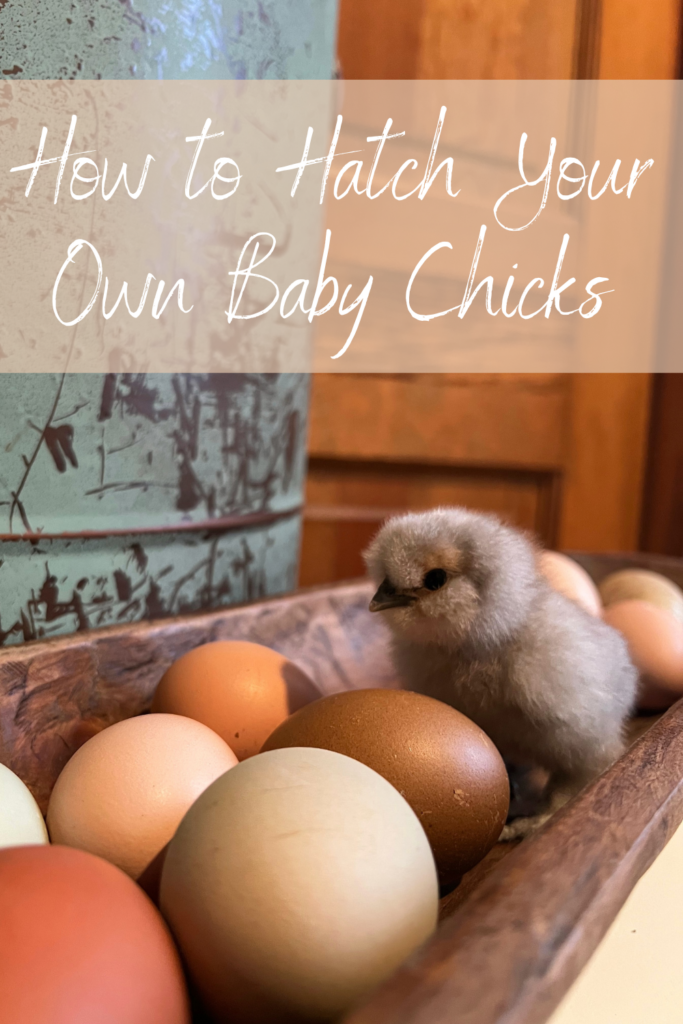
It is important to note that the advice in this post is specific to hatching chicken eggs. Eggs from other species of bird such as duck eggs will require different temperatures, humidity, turning frequency, and duration. This guide also assumes that you have chosen not to use a broody hen to hatch your clutch of eggs. Without a mother hen, a successful hatch will require an incubator for proper temperature and humidity control to produce a healthy chick after the 21-day incubation period.
This post does contain an affiliate link. As an amazon associate, I earn from qualifying purchases. I only provide recommendation on products that I personally use and trust. If you choose to purchase through my amazon link in the post below, I make a commission at no additional cost to you.
What is the hatching process?
- Gather fertile chicken eggs and store appropriately until ready for incubating
- Place eggs in incubator according to incubator-specific instructions
- Set and maintain a temperature of 99.5 degrees Fahrenheit from start to hatch
- Set the humidity level to 50% for days 1-18
- Ensure eggs are rotating adequately throughout the day for day 1-18
- Check eggs by candling on days 7 and 14
- Adjust the humidity level to 70% for days 19-21
- Allow hatching chicks to remain in the incubator for 12-24 hours
How do I know if my eggs are fertilized?
Firstly, do you have a rooster intermixed with your ladies at a healthy hen to rooster ratio (10:1). Secondly, did you purchase fertilized eggs from someone else (a hatchery or someone in the local community)? If you said yes to either, or both, of these questions, then chances are your eggs are fertilized. There are a few reasons why this might not be true. Stress, genetics, diseases, and nutrition all can contribute to the viability of an egg.
Eggs from grocery stores are not fertile. And, a rooster is not necessary for a hen to lay eggs, but they are necessary to fertilize eggs. Producing and laying eggs is a natural part of a hens reproductive cycle. In order for an egg to become fertile, a rooster and a hen need to mate. During mating, the male’s sperm must be deposited within the hen’s cloaca at which point it should travel up the oviduct, and fertilize eggs prior to the development of a harder outer layer shell.
If you wonder if your chicken’s eggs are being fertilized by your rooster, the next time you crack an egg for cooking or baking, you can look for a white dot within the egg yolk. This is called the germinal disc and it indicates your rooster is adequately fertilizing your eggs.
How to store your eggs before incubating
Store the fertilized eggs in a cool place (55-65 degrees F) and away from windows and drafts. I like to place mine in an egg carton. It is important that the hatching eggs be stored with the large end of the egg up (pointed end down) so that the air sac will rise and not get misplaced. A misplaced air sac jeopardizes the quality of the yolk and hatchability of the egg.
How long do eggs take to hatch?
Hatching eggs is a 21-day incubation period. Eggs can be set aside at a cooler (not cold) temperature and will remain dormant for 7-10 days before incubation. Hatch quality drastically begins to reduce after 10 days. The chances of hatching an egg that has been sitting on the counter for 3 weeks is essentially zero.
If your eggs are beyond 10 days, they are not ideal candidates for hatching but they are great for hard-boiled eggs. I have a method for easy-to-peel hard-boiled eggs that will put your older eggs (2-3 weeks old) to great use! If you have already started incubating your eggs and later discover they are no longer viable, I do NOT recommend consuming these eggs.
What temperature and humidity do you hatch eggs?
Before incubation, hatching eggs should be stored below room temperature. Somewhere in the low 60’s will do. Once you begin the incubation process, you will need to monitor the temperature and humidity very closely. I suggest testing your incubator and calibrating it with an external thermometer before setting your eggs up to incubate. Temperature within the incubator should be 99-100 degrees Fahrenheit throughout the 21-day incubation process. Humidity for the first 18 days should be around 50% (45-55% is acceptable). For the final 3 days (days 19-21), humidity levels must be increased to 70% (65-75% is acceptable). Refer to your incubator’s user manual for a complete guide on how to adjust temperature and humidity.
It is important that you do your best but hold it lightly (advice from a yoga teacher). In nature, mother hens have to get off of their eggs to eat and drink. If you notice a temperature or humidity drop, do your best to bring it back to the recommended levels as soon as possible. My very first hatch, the humidity dropped to 4% overnight, I fixed it immediately the next morning and my hatch rate was still 100%. Do not fret too much. You can only correct it now and move forward.
How often should your turn your eggs during incubation?
It is important to turn incubating eggs for the first 18 days to prevent the yolk from touching and attaching to the inner membrane. Once the yolk attaches to the wall, the egg is no longer a viable candidate for hatching.
If you do not choose an incubator with an automatic egg turner, you will need to manually turn your eggs. Minimally, eggs should be turned 3-5 times in a 24 hour period. To keep track of if the eggs have been turned, I recommend marking the side of your egg so that it is evident that it has been rotated. A really great way of tracking without needing to keep a log, could be marking 1-5 around the width of the egg. Starting the day on 1, rotating to 2-4 throughout the day, and ending the day on 5. Starting again at 1 the next morning. Turning eggs by hand can be very demanding. If you have the means, I highly recommend investing in an egg turner or an incubator with a built in egg turner.
If you do have an automatic egg turner, this will save you the headache of manually turning your hatching eggs. I still recommend marking the egg to ensure the eggs are rotating and not just sliding along on their side. Most automatic egg turners will rotate the egg every hour, which is the most ideal frequency.
For the final 3 days of incubating, it is vital that the eggs NOT be rotated or adjusted in any way. This provides the chick’s body time to properly position itself as it prepares to hatch. Continuing to rotate the egg will disrupt this process.
How to choose the right incubator
The most important two features when buying an incubator is temperature and humidity controls. Anything else is just nice to have!
I personally use the Harris Farms Nurture Right 360 which I purchased through Amazon. I have learned my lesson on cutting corners with cost. You always get what you pay for. When you pay for quality, you save in time, hard work, and heartache. An amazing thing about purchasing through Amazon is you can purchase in installments so you can still make it work regardless of your current cash flow situation.
My favorite features of the Nuture Right 360 model from Harris Farms is the automatic egg turner, the built in candling light, and the precise heater and humidity control. It makes each hatch so hassle free. I like to set it up in my living room on a side table. If you can, avoid setting it up in a location that you won’t visit frequently. You need to be able to check on the incubator temperature and humidity levels at least 1-2 times a day. If water level decreases, the humidity will drop fast so its best to keep it where you know you will check on it.
It is best not to place the incubator on the floor as there is a higher concentration of carbon dioxide closer to the floor, limiting the availability of fresh air. Avoid placing it near a window where it may sit in direct sunlight or be susceptible to drafts.
How to check on your developing eggs
In order to check the status of your hatching eggs, you can use the candling method. You will do this with a powerful flashlight, not a candle! Ironically, that is how it earned the name but we aren’t that old fashioned. It is with a strong light that you will be able to observe the growth and development of the embryo within the egg. I will often candle my hatching chicken eggs three times throughout the incubation process – before incubating, at day 7 and again at day 14.
Before incubating, candling allows you to check for cracks and age quality. Holding the light source up to the egg, a fertile egg that is ready for incubating will light up evenly throughout. A cracked egg is vulnerable to bacterial infection which will kill the embryo. An egg that has been sitting on the counter for longer than 10 days will develop a cloudiness from the yolk attaching to the inner membrane.
After the first week of incubation (days 7-10), you will be able to candle the eggs to check development. A healthy, developing embryo will appear as a dark dot and the spreading of blood vessels. Depending on the side you are candling, you may not be able to see the small embryo. Be sure to rotate the egg thoroughly before making your decision. This is also a great time to start measuring the air cell. Using a graphite pencil and a flashlight, trace an outline of the air sac at the wide end of the egg.
Two weeks into incubation (days 14-17), your hatching chicken eggs are almost ready for the big day. In this window, we are looking for continued embryonic development and veining. The chick embryos will start to fill the egg and you will notice less movement, purely due to limited space available in the egg. Once you reach the final three days before hatching, it is best to not disturb the eggs. You really won’t be able to see much between days 18 and 21 anyways as the chick takes up most of the space within the egg.
How to tell if the embryo is no longer viable in the egg
Embryo death will primarily occur at two high-risk periods: at the start of incubation and just before hatching. It is normal for some losses to occur. An 80% hatch rate, on average, is considered a successful hatch rate. A average loss rate greater than 20% is worth investigating and identifying a root cause.
After a week of incubating, it will be clear if you do not have a fertilized egg, you will not see any veining or an embryo. The egg will light up evenly throughout just as it did on day 1. Early embryonic death, on the other hand, will be evident by the presence of a blood ring; a thin ring around the inside of the egg. By day 14, any “quitters” are identifiable as they will just not have progressed much since day 7.
Remove any non-viable eggs from the incubator as you discover them. Continuing to incubate these eggs will allow them to become rotten. Rotten eggs can sometimes explode within the incubator, contaminating your other fertile eggs and creating a massive mess within the incubator.
How long do I leave hatching chicks in the incubator?
When your baby chicks begin to hatch, they will first pip the egg, creating a small hole where the chick can take its first real breath of air. Following the pip is a zip. The hatching chick will peck a straight line across the width of the egg shell until they are able to emerge from the egg. Don’t be too quick to remove the newly hatched chicks from the incubator. Give them time! Ideally, the chicks will be dry and able to walk well on their own before removal. If you remove them too soon, they can catch a chill which can be difficult for them to recover from. I personally like to leave my chicks within the incubator for 12 hours after the last chick has hatched.
Chicks can remain within the incubator 24-48 hours without the need to supplement food and water. Isn’t that amazing? They absorb all of the nutrients they will need for the first days of life all from the egg yolk.
Depending on the amount of space in your incubator, you can remove the excess egg shells. Sometimes these shells can get in the way or even push up against eggs that haven’t hatched yet and hinder their ability to do so. If you do decide to open the incubator, be very quick and intentional about it. Again, you don’t want to disturb any hatching eggs and you don’t want to alter the internal temperature and humidity.
If this is your first hatch, I am so excited for you! This is such a rewarding journey to travel down. There will inevitably be bumps along the road but that is the path to learning and living. Have courage to move forward.
Wishing you all of the joy and happiness!
Love, Bailee
Leave a Reply